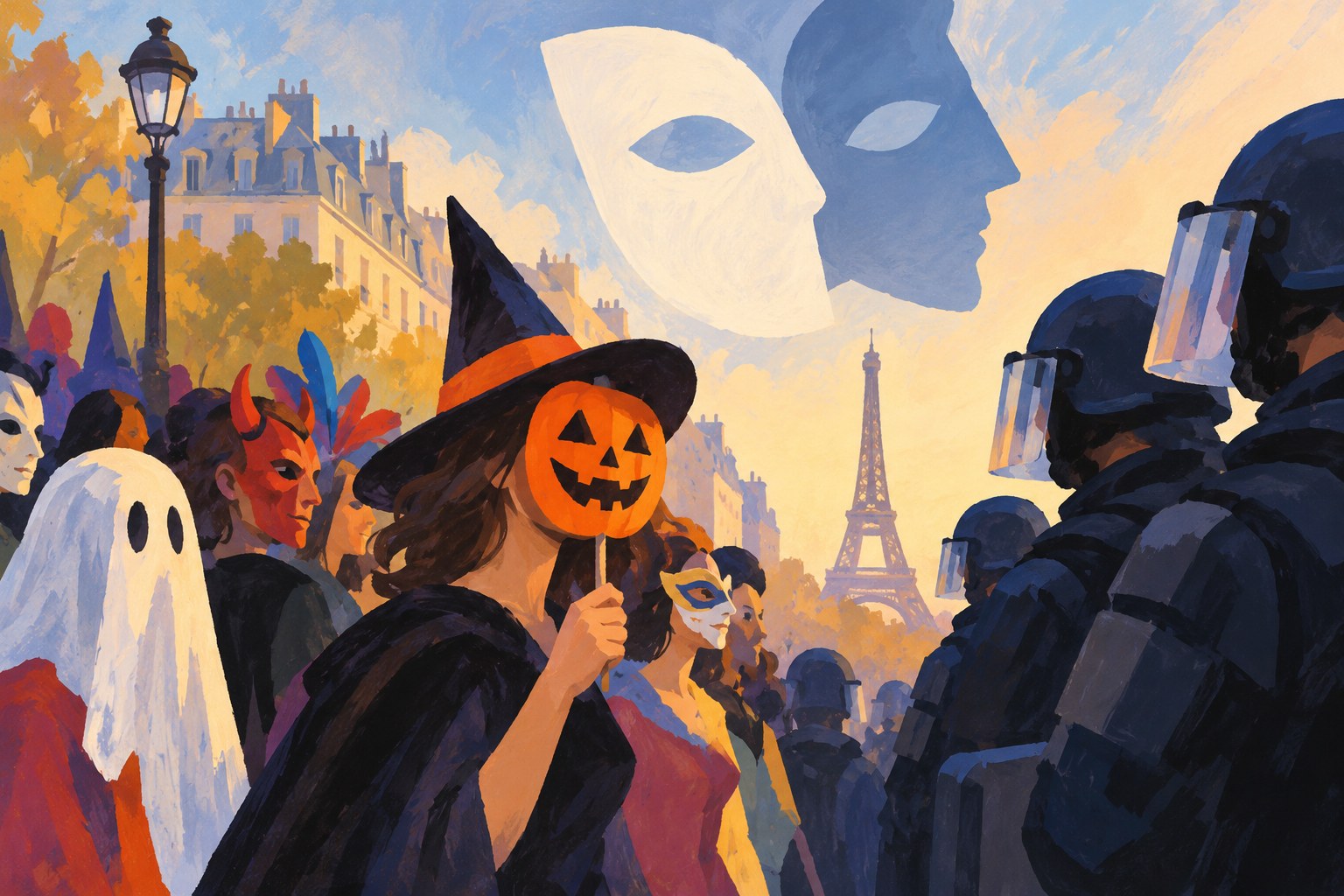
Paris’s protest on 31 October turned a calendar coincidence into a political test. By arriving in costumes and with covered faces, some demonstrators visibly challenged France’s restriction on deliberately concealing one’s face at a protest. The rule can carry a fine of up to EUR1,500, according to elDiario.es. Our judgment is specific: a rule intended to help identify violent offenders loses legitimacy if, amid an exceptional police deployment, it gives authorities an insufficiently clear basis to treat protected protest as inherently suspect.
The documented event is a third consecutive Saturday of protest. elDiario.es reported that the march followed an authorised outer route from Porte de Bagnolet to Porte de Charenton after the Paris police prefecture refused organisers’ request to cross the city centre. It described a mixed crowd bringing together demands over living costs and education conditions, alongside allegations of police violence and anti-racist slogans. El Mundo separately reported calls on social media for people to attend in costume, in a context it described as marked by curfews and high tension.
This is not merely Halloween theatre. A protester quoted by elDiario.es said she and others wore FFP2 masks to protect themselves from tear gas and feared arrest. That is an attributed claim, not proof of police conduct. Yet it identifies the operational problem: a face-covering ban may capture both someone evading accountability and someone claiming protection during a police charge.
The counterargument is substantial. Following the unrest of 17 October, which elDiario.es placed in a context of looting and arson, authorities can reasonably argue that identifying people who commit violence is a public-safety necessity. The right to demonstrate does not shield vandalism or prevent prosecution of those responsible.
That is precisely why enforcement cannot be indiscriminate. The next concrete issue is whether police issue fines or make arrests over masks at this march, and what criteria they use to distinguish costume, protection and concealment intended to facilitate an offence.
Sources
- elDiario.es · Source date: 2026-10-31
- El Mundo · Source date: 2026-10-31
Independent editorial content. WUA is not affiliated with any political party. 2026-10-31