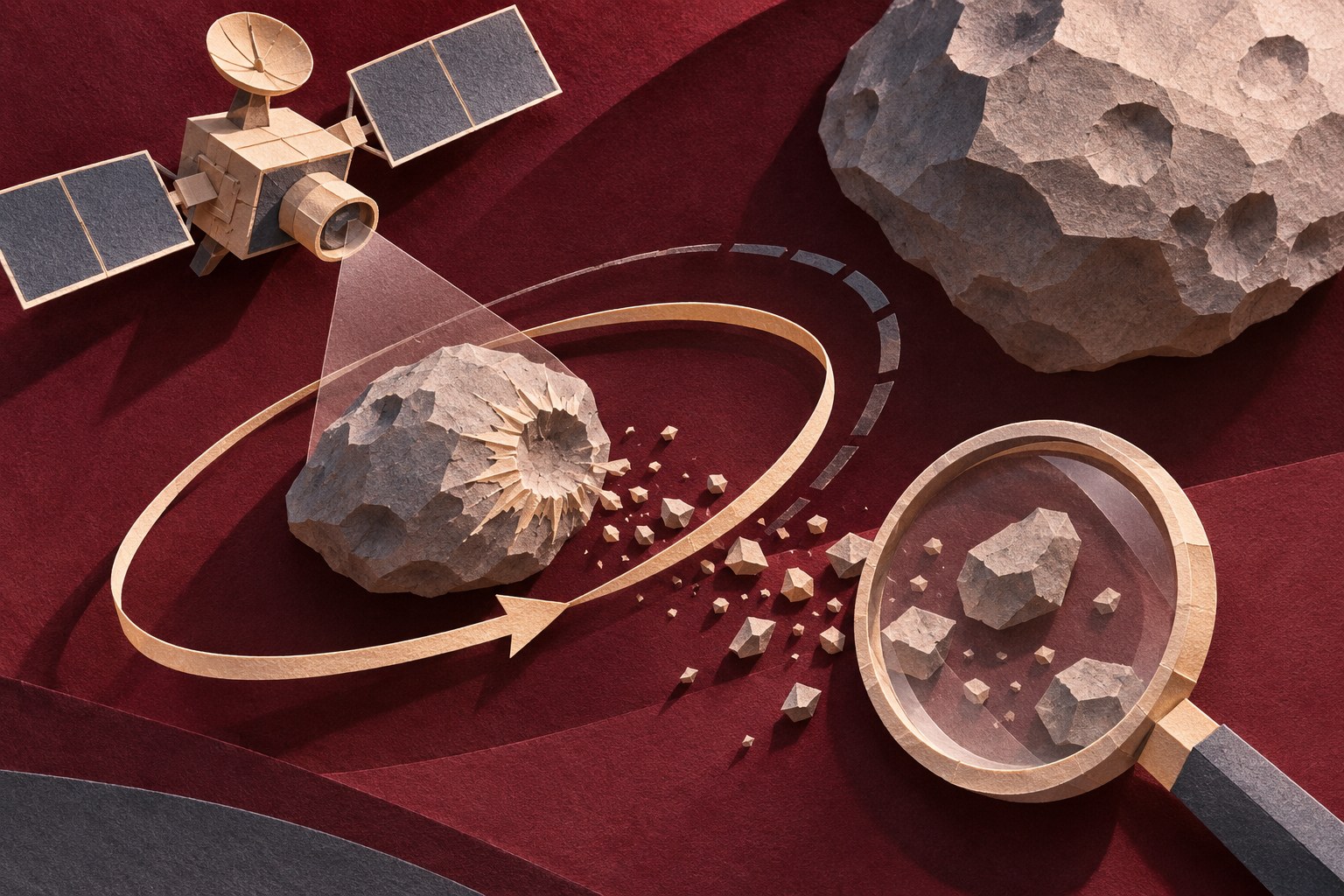
ESA's Hera spacecraft has taken its first close image of the Didymos-Dimorphos asteroid system from about 60 km away. Its importance is not that it settles the case for planetary defence, but that it begins the measurements needed to explain the result of NASA's DART impact experiment.
NASA's DART spacecraft deliberately struck the smaller asteroid, Dimorphos, in 2022. Nauka w Polsce reports that Dimorphos's orbital period around the larger Didymos became 33 minutes shorter after the collision, a larger change than expected. That was a visible human-caused change to an asteroid orbit, but the shorter period alone does not explain how the impact energy moved through the object's loose, rocky structure.
The new image chiefly reveals the opposite side of Didymos. Scientists cited by the report describe boulders, craters and features resembling grooves or ridges. Material ejected by the DART collision may have crossed the roughly one-kilometre gap between the two bodies. Hera is now expected to examine the impact site and map changes across the system.
That work is what gives the mission its practical value. A kinetic impact cannot become a dependable way to redirect a potentially hazardous asteroid simply because DART shortened Dimorphos's orbit. Researchers still need to establish how the crater, the ejected material and the surface properties shaped the outcome. Hera can turn a striking one-off demonstration into evidence that supports more precise future mission design.
Source: Nauka w Polsce / Fundacja PAP.
Sources
- Nauka w Polsce · Fundacja PAP — Źródło: Nauka w Polsce (Fundacja PAP) (https://naukawpolsce.pl/) · Source date: 2026-11-09
Independent editorial content. WUA is not affiliated with any political party. 2026-11-09