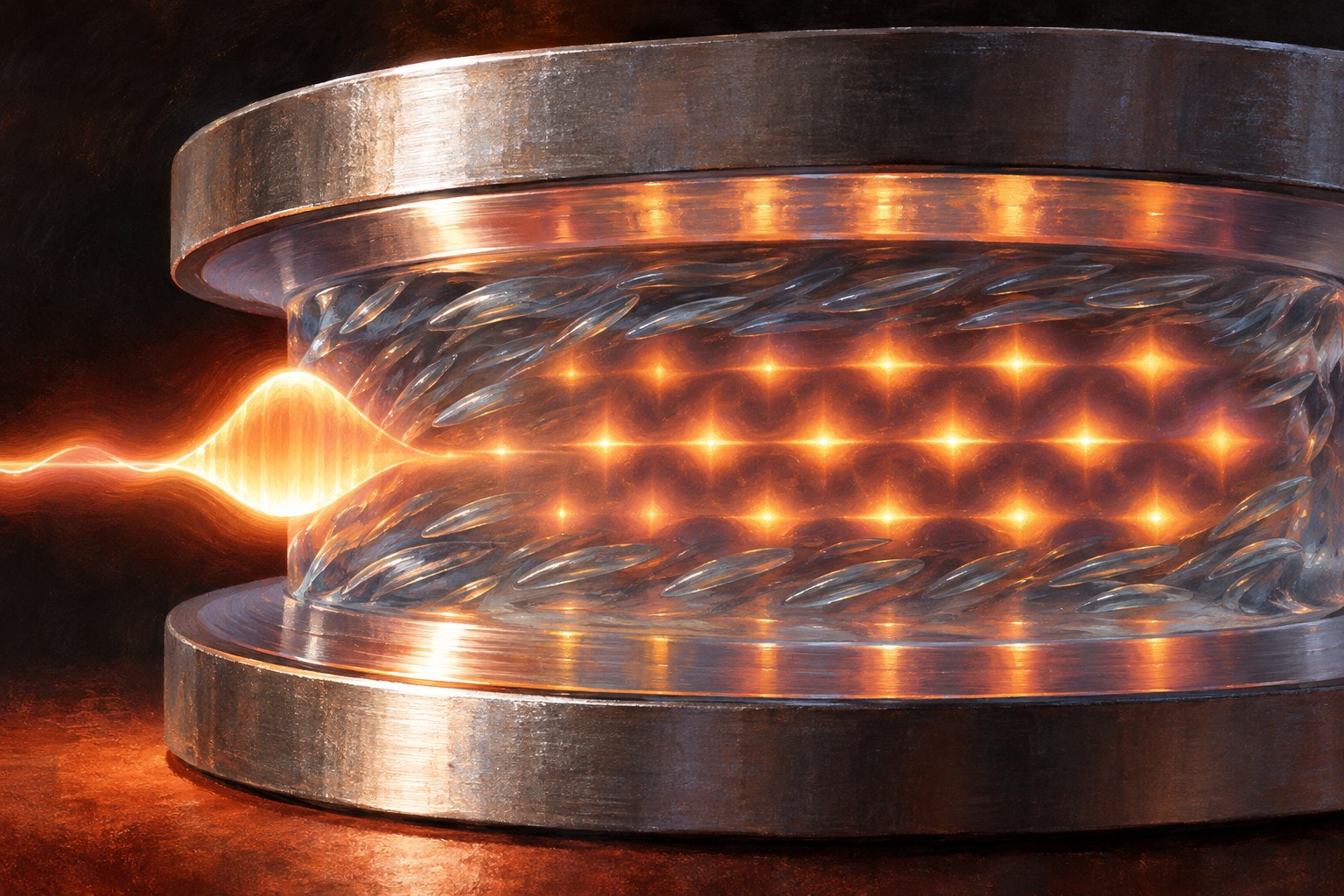
A team led by physicists at the University of Warsaw has produced a quantum supersolid at room temperature using light confined in an optical microcavity. The significance is not that a new computer or sensor is ready for deployment. It is that a state normally studied under temperatures close to absolute zero may now be investigated on a more accessible experimental platform.
According to Nauka w Polsce, the researchers trapped light between two mirrors separated by only 2–3 micrometres. An organic dye and liquid crystal in the cavity produced exciton polaritons: quantum states combining properties of light and excited matter. By controlling the liquid crystal with voltage while using short laser pulses, the team formed a Bose-Einstein condensate that spontaneously developed a periodic structure.
A supersolid combines features that appear contradictory: the flow properties associated with a frictionless fluid and the regular ordering associated with a crystal. The key advance in the Warsaw work is the ability to observe such behaviour without complex cryogenic cooling. The team said its optical microcavities can operate at around 60°C, while the reported supersolid experiment was conducted at room temperature.
That distinction matters. This is basic research, not a demonstration of a market-ready device. The researchers are still examining how stable the phase is and refining the microcavity materials. Sensors, optical-computing systems and components for room-temperature neuromorphic computers are research directions proposed by the team, rather than products with a timetable.
The results were published in Science Advances. The Warsaw group is not claiming the first supersolid observation worldwide: Nauka w Polsce reported that researchers in Italy published similar results earlier. The value of the Warsaw result lies elsewhere: it offers a way to study an unusually difficult quantum state without relying on extreme cooling.
Sources
- Nauka w Polsce · Fundacja PAP — Źródło: Nauka w Polsce (Fundacja PAP) (https://naukawpolsce.pl/) · Source date: 2026-11-10
Independent editorial content. WUA is not affiliated with any political party. 2026-11-10