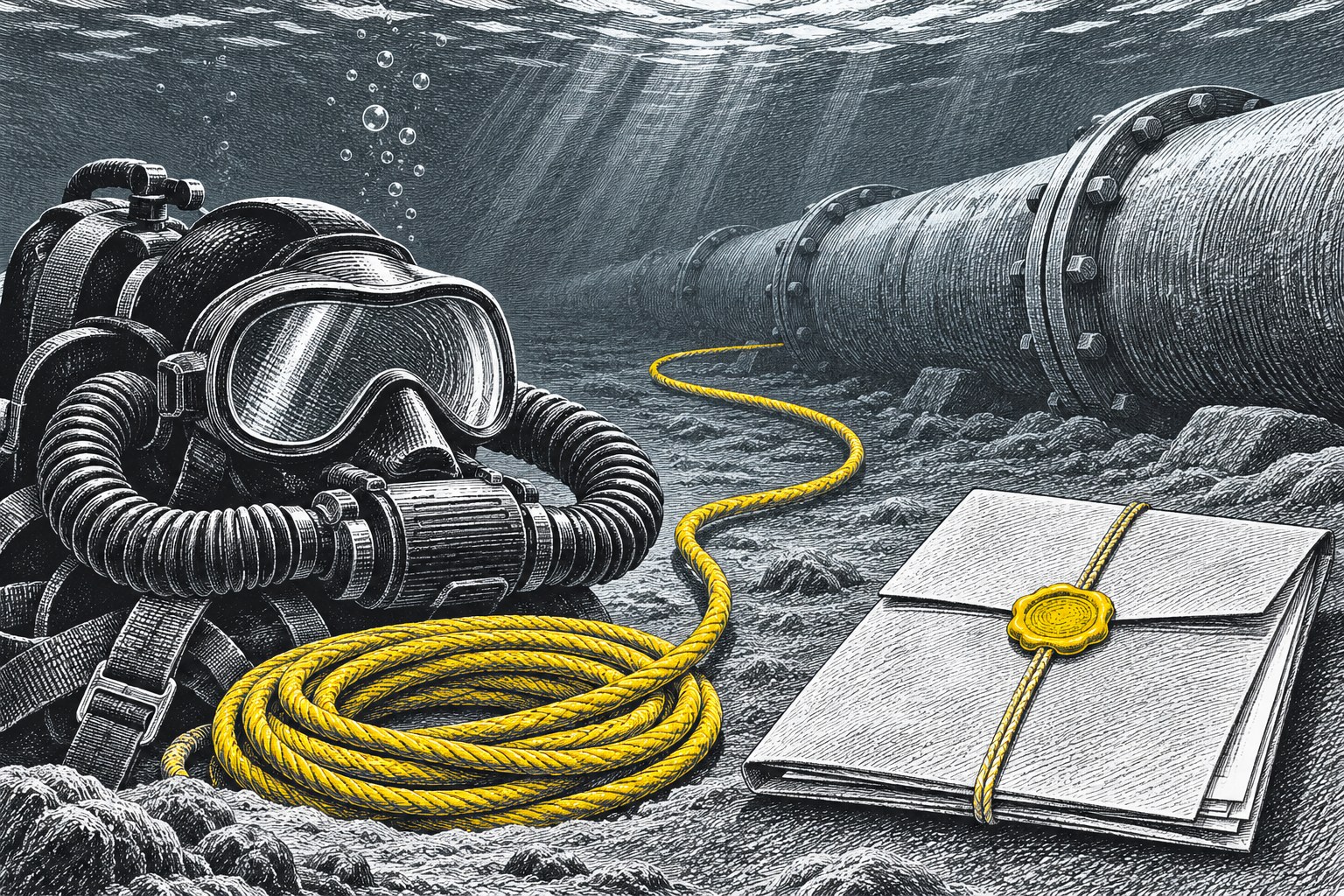
A Bundeswehr mine-diving expert has told the Hamburg Nord Stream trial that experienced divers could place explosive charges at depths of up to 80 metres. The testimony makes the prosecution’s proposed method more technically concrete. It does not answer the central question of the case: who planned, carried out or ordered the sabotage.
According to Der Spiegel, the expert said compressed air should not be used at such depths. He instead described a trimix gas mixture and a closed-circuit breathing apparatus. He estimated that a dive to about 74 metres, including decompression, would take around 128 minutes. In his view, charges weighing 14 to 27 kilograms could be lowered as a package and attached to the pipelines. He also considered the suspected sailing yacht Andromeda suitable for the operation.
That evidence matters because it addresses a practical part of the alleged sequence of events. But an expert’s view that an operation was feasible is not evidence identifying the people involved. It does not establish who dived, who directed them, or whether anyone authorised the operation.
Federal prosecutors allege that Serhij K., a former officer in a Ukrainian special unit, coordinated the explosions with six other participants. He faces charges including war crimes. Those are prosecutorial allegations; the court has not yet ruled on his criminal responsibility.
That distinction is essential in a politically charged sabotage case. Technical feasibility may form one part of an evidentiary case. It cannot substitute for evidence connecting a particular defendant to planning, execution or an order.
Sources
- Der Spiegel · Source date: 2026-11-10
Independent editorial content. WUA is not affiliated with any political party. 2026-11-10