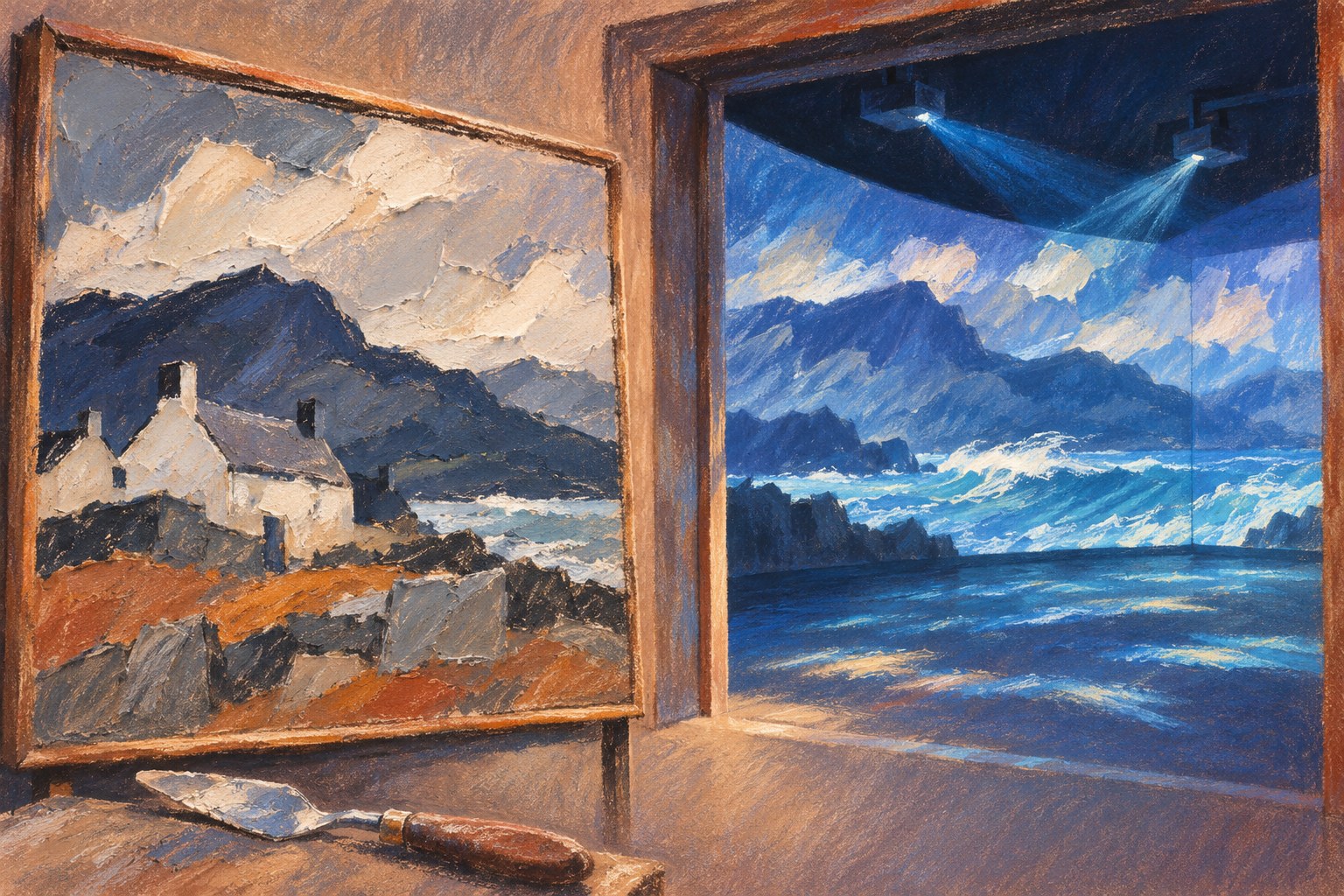
Profiad Kyffin Experience, opening at the National Library of Wales in Aberystwyth on 18 November, makes a serious case for immersive art when it is used to unlock a public collection rather than merely manufacture spectacle.
The free, bilingual exhibition animates and scores works by Sir Kyffin Williams, whose thick palette-knife landscapes, farmers and coastal scenes have long helped shape a popular visual idea of Wales. It is deliberately small: visitors move through three rooms, with no more than 10 admitted at once. In the main space, projected landscapes and seascapes cover the walls, floor and ceiling alongside music by a Welsh chamber-folk string trio. A final room includes a touchable electronic treatment of a self-portrait intended to convey the density of Williams’ paint.
That format matters because the National Library holds the world’s largest Williams collection: 200 oil paintings, 300 original prints and more than 1,000 works on paper. Much of it is kept in storage, available by appointment or in the reading room. Bringing selected works to the front of the building gives visitors a route into an archive that can otherwise feel remote, and the bilingual framing fits an artist so closely associated with Welsh place and hiraeth.
The exhibition’s test is not whether projections can outdo paintings. They cannot reproduce the physical resistance of paint, scale, or the encounter with an original object. The show’s designers acknowledge that tension: Focal Studios said it spent months studying the works to retain the sense of Williams’ palette-knife texture. The tactile self-portrait is therefore more than an interactive extra; it points to the material quality that animation risks smoothing away.
Immersion can still be a worthwhile invitation. Its value here lies in directing attention back to Williams, the library’s collection and the landscapes from which the work emerged. With a planned run of three to five years, Profiad Kyffin should be judged by whether it encourages that deeper encounter, not by the movement on its walls.
Sources
- The Guardian · UK · Source date: 2026-11-14
Independent editorial content. WUA is not affiliated with any political party. 2026-11-14