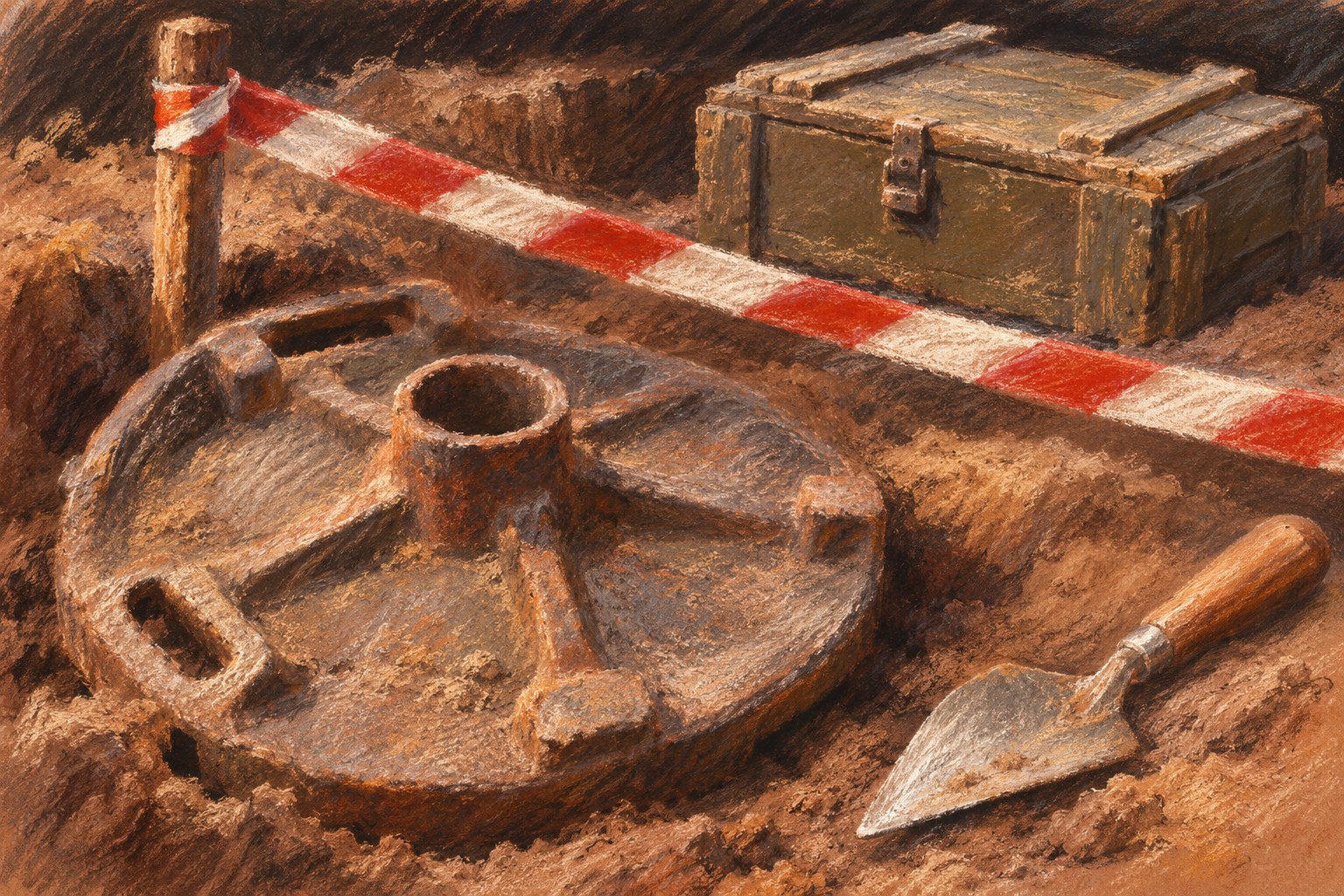
Westerplatte’s thirteenth archaeological season has produced important material evidence, but it has also exposed a safety burden that cannot be treated as a footnote. More than 28,000 pieces of ammunition and other hazardous items were secured, underlining that opening further parts of the peninsula to visitors depends first on painstaking work to make the site safe.
The Museum of the Second World War carried out the excavation from 9 April to 10 August 2026 across 479 square metres of the former parade ground and the new barracks area. Nauka w Polsce reported that archaeologists uncovered reinforced-concrete remains of an armoury, a garage with an inspection pit and a ramp. Nearly 900 of the roughly 2,700 recovered objects were judged highly valuable, including a base plate for a Polish 81 mm wz. 1931 mortar, a fragment of window surround with camouflage paint and a damaged Polish military mess tin.
These finds are more than a new collection of museum objects. Archaeologist Adam Dziewanowski said the excavated level was a place used by Polish defenders in 1939, and that the work will help expose and make the structures accessible as part of the Museum of Westerplatte project. That ambition is sound, but the reported volume of hazardous material makes the sequence clear: preservation and public access must follow thorough safety work, not overtake it.
A separate discovery on 5 November, made during parallel construction work, requires equal restraint. Human remains were found with Polish military buttons and a bayonet. The equipment may indicate that the remains are those of Mieczysław Krzak, a sought-after defender of the peninsula and a legionnaire, according to the report. It is a significant lead, not an identification. Nauka w Polsce did not report forensic or DNA results, so attaching Krzak’s name to the remains as a settled fact would go beyond the available evidence.
The season gives Westerplatte a more tangible record of its history. Its credibility will rest on both parts of the work: safely dealing with what remains in the ground and allowing formal evidence, rather than expectation, to establish the identity of any person found there.
Sources
- Nauka w Polsce · Fundacja PAP — Źródło: Nauka w Polsce (Fundacja PAP) (https://naukawpolsce.pl/) · Source date: 2026-11-14
Independent editorial content. WUA is not affiliated with any political party. 2026-11-15