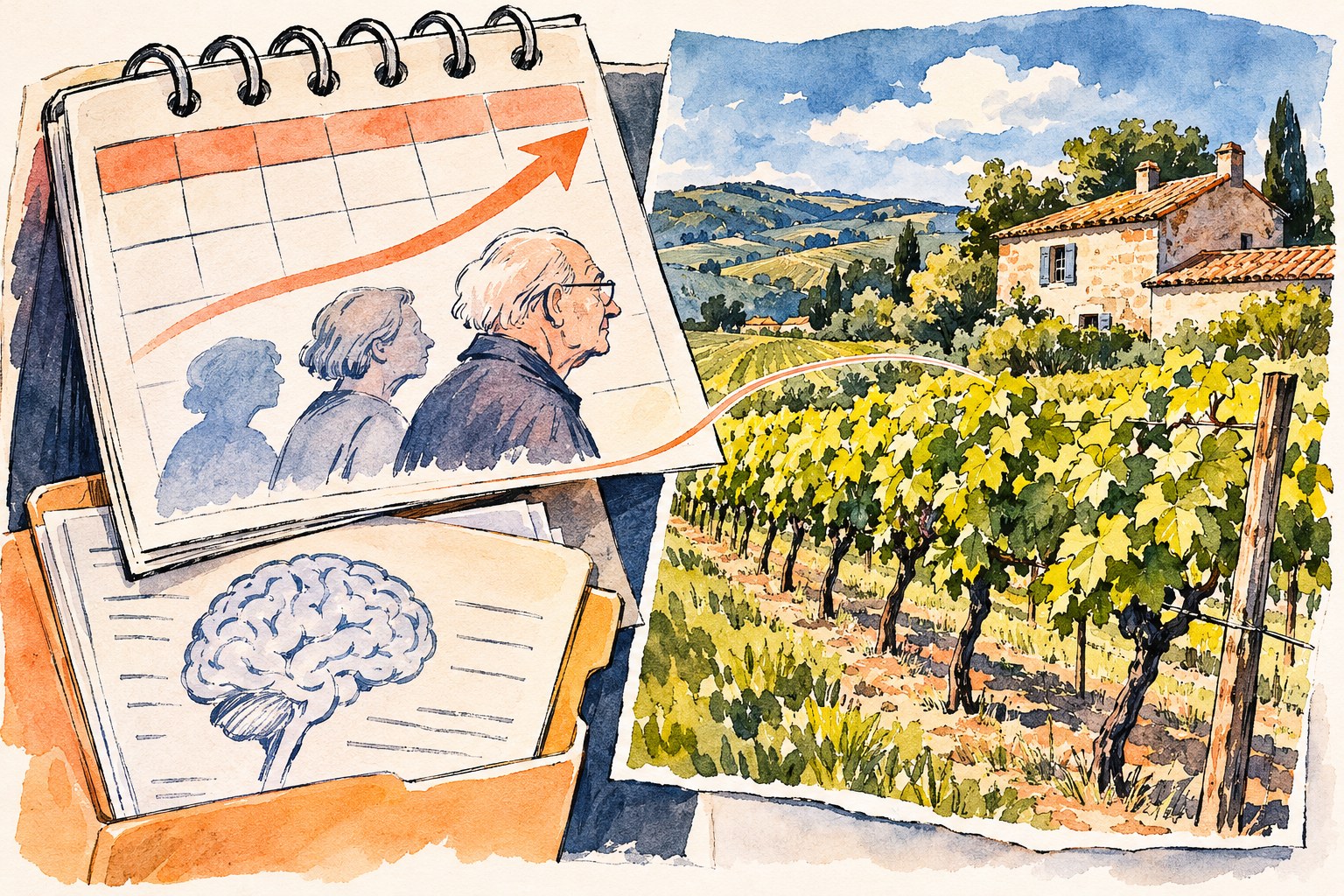
France’s first national Parkinson’s observatory shows a public-health burden that cannot be described as ageing alone. Ageing remains the main explanation for the overall rise, according to neurologist and epidemiologist Alexis Elbaz as quoted by franceinfo. But the territorial differences reported alongside it warrant more rigorous investigation of environmental exposure.
Franceinfo reports that nearly 300,000 people in France have Parkinson’s disease and that a new case emerges roughly every 20 minutes. Its November 15 report says one in five patients was under 65 at diagnosis, citing the first national observatory developed with Santé publique France. This makes Parkinson’s a large-scale public-health issue, not simply a condition of old age.
Vienne saw an 85% increase in new cases over ten years, franceinfo reports. Mayenne was said to be close to that figure, while Hérault, Bouches-du-Rhône and Gironde had more cases than the national average. The report notes that these departments have substantial cereal, vineyard or orchard cultivation.
That pattern is a signal, not proof that pesticides caused an increase in any one department. Elbaz refers to California research associating residence near pesticide-treated fields with a higher Parkinson’s risk, while stressing that France does not have equally detailed data. The French studies cited by the report found higher incidence in highly rural areas and somewhat higher incidence in wine-growing regions. They do not identify a specific product or exposure as the cause of a local rise.
That distinction is the value of the observatory. Ageing and environmental exposure are not rival explanations from which to pick one. The first helps explain the national trend; the second supports the case for better documented local research. Without the methods, local denominators and exposure measures absent from the supplied material, turning a geographic correlation into a pesticide verdict would weaken the public-health debate rather than clarify it.
Sources
- franceinfo Tous titres · Source date: 2026-11-15
Independent editorial content. WUA is not affiliated with any political party. 2026-11-15