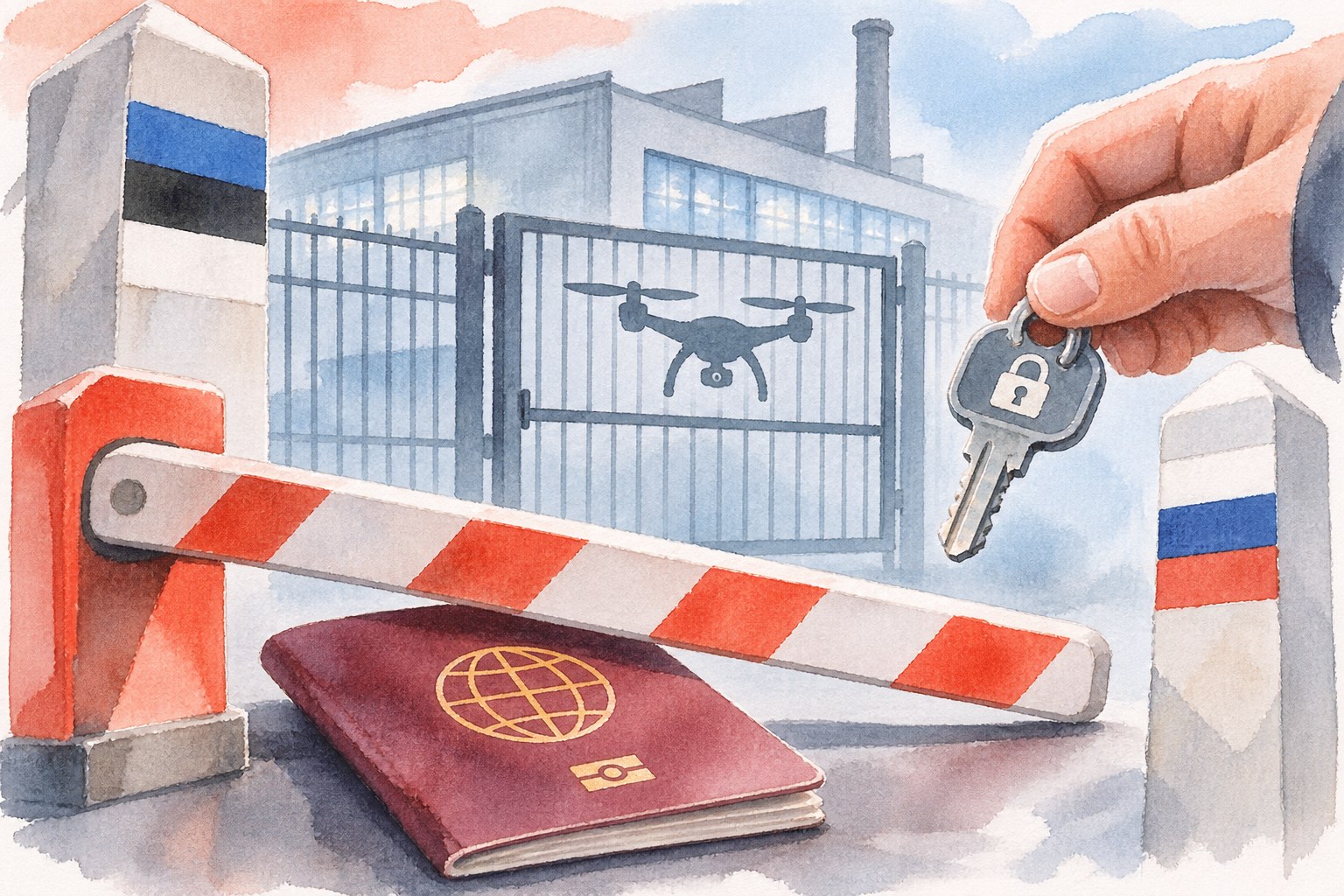
Estonia will close every crossing on its border with Russia on 1 December. Announced on Sunday, the move is a state-level response to an attempted arson attack on a drone factory that Tallinn says it foiled and attributes to Russian military intelligence, the GRU.
The key distinction is straightforward. The border closure is an announced measure with a stated start date. The identity of those behind the alleged arson attempt remains Estonia’s attribution. According to franceinfo, Foreign Minister Margus Tsahkna said shutting the crossings would reduce Russia’s ability to conduct hostile activity in Estonia and strengthen efforts to prevent sanctions evasion.
The measure takes the response beyond the industrial site at the centre of the allegation. Rather than treating the episode solely as an investigation into an attempted arson attack, Tallinn is using border policy to address what it describes as a wider security risk. Its judgment is clear: access across the border is being treated as a tool of security and sanctions enforcement.
That tougher response does not remove the need to separate the decision from its stated rationale. The supplied material does not identify the location of the alleged attempt, any suspects, or the investigative evidence behind Tallinn’s attribution to the GRU. It also contains no Russian response. The announced closure therefore should not be read as independent proof of who organised the alleged operation.
The practical terms are still not set out in the available reporting. It does not say whether humanitarian travel, cross-border commuters or freight will be exempted. For now, the development is the announced full closure from 1 December and Tallinn’s stated purpose: using border access as a response to activity it attributes to Moscow.
Sources
- franceinfo Tous titres · Source date: 2026-11-15
- France 24 Tous titres · Source date: 2026-11-15
- Le Figaro Actualités · Source date: 2026-11-15
Independent editorial content. WUA is not affiliated with any political party. 2026-11-15