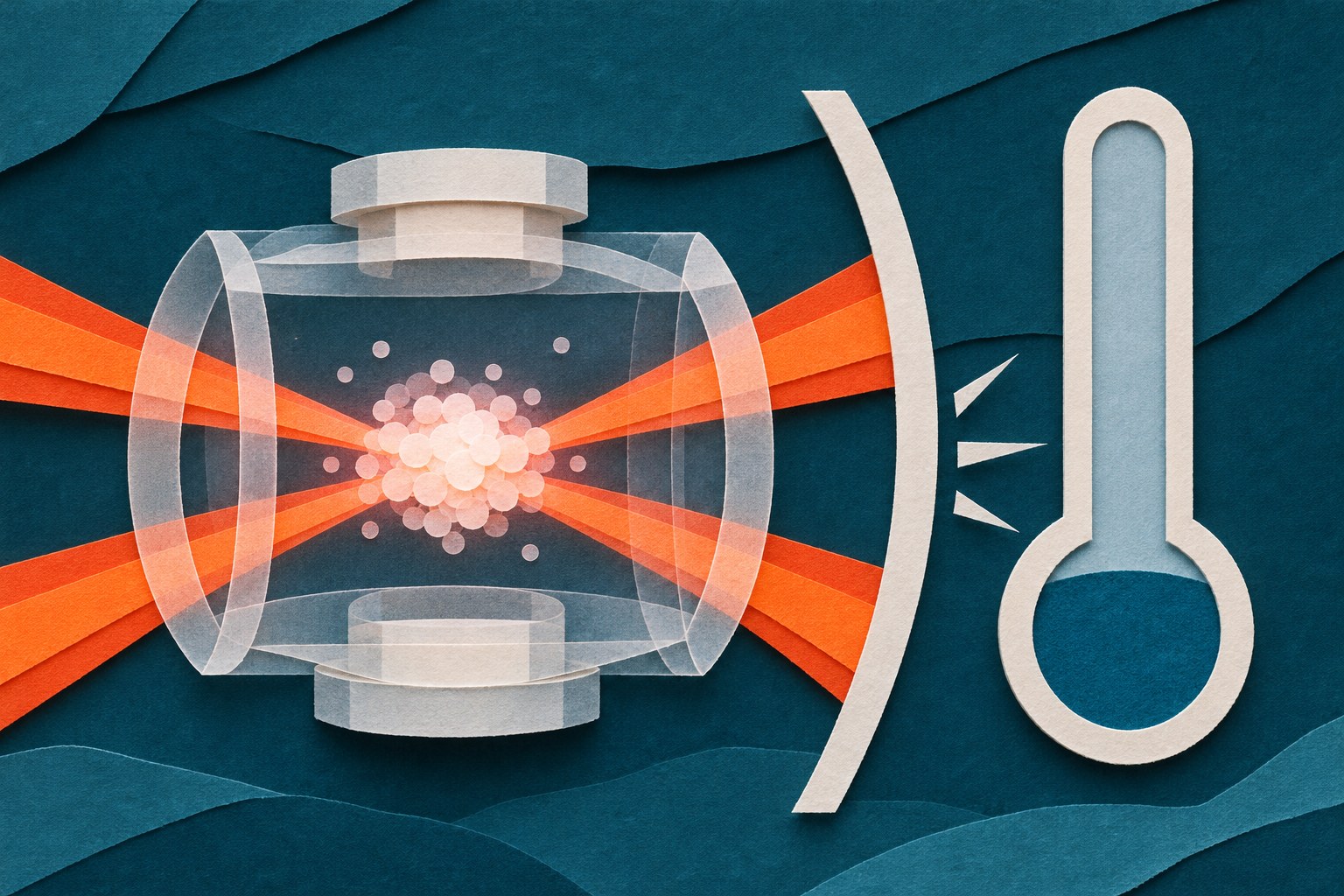
An experiment on China’s Tiangong space station cooled roughly 2,000 rubidium atoms to 9.7 picokelvin, the lowest temperature ever measured, according to Dagens Nyheter. That is a genuine, unusually precise research milestone. It becomes more meaningful, not less impressive, when it is kept distinct from the unreachable limit of absolute zero.
A temperature of 9.7 picokelvin is 9.7 trillionths of a kelvin and, DN reports, about one quarter of the previous 2021 record. The experiment took place in Tiangong’s microgravity environment. Researchers used two crossing laser beams to polarize and trap the atoms inside a 54-micrometre enclosure.
Xuzong Chen of Peking University, one of the researchers, told DN that the team then expanded the trap. Reducing interactions between the atoms lowered their energy and motion. By the end, they were moving at less than 200 micrometres per second. The process produced a Bose-Einstein condensate, a state in which atoms under extreme conditions can occupy the same quantum-mechanical ground state.
It would nevertheless be misleading to portray the experiment as having switched off motion or reached physics’ final boundary. Absolute zero, 0 kelvin or minus 273.15 degrees Celsius, is a theoretical limit. The laws of thermodynamics prevent a system from being cooled all the way to it.
That distinction is precisely why the record matters. Lower temperatures offer more extreme conditions for studying ultracold gases and the quantum behaviour of particles. But DN’s report does not provide an original paper, measurement uncertainty or a full account of how the comparison with earlier experiments was standardised. The reported record should therefore be treated as a substantial experimental achievement, while broader claims about applications go beyond the evidence currently available.
Sources
- Dagens Nyheter · Source date: 2026-11-16
Independent editorial content. WUA is not affiliated with any political party. 2026-11-16