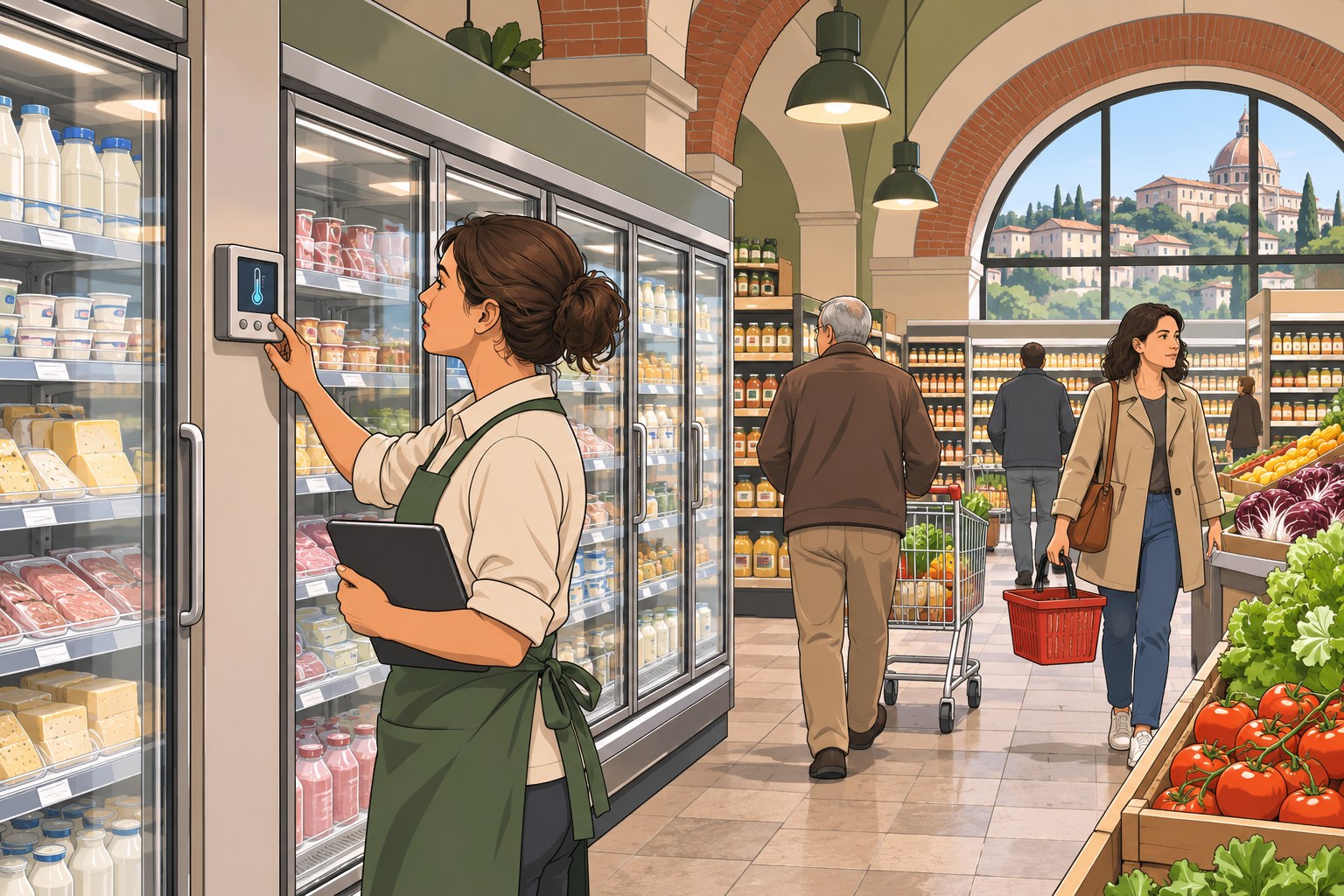
Italy supermarket cyberattacks have become a food-supply resilience issue not because a food shortage has been established, but because refrigeration systems link food safety, stock management and delivery continuity. The task now is to test the risk transparently, not to declare a crisis that the available evidence does not show.
On 2 November, ANSA reported that postal police were tracing the origin and scale of intrusions affecting refrigeration systems in Sicilian supermarkets. La Repubblica Palermo reported affected stores in Palermo, Catania and Ragusa, describing more than 10 supermarkets and abnormal temperatures in chilled cabinets and freezers. The supplied reports do not identify the attackers or establish a food shortage.
The issue has acquired national weight because reports extend beyond Sicily. ANSA said Italy's National Cybersecurity Agency received an incident notification from a Tuscan company and detected an attack on an Emilia-based business. A meeting at Palazzo Chigi involving Alfredo Mantovano and the intelligence services is scheduled for 3 November, with the cybersecurity agency's director due to attend. Copasir, Parliament's intelligence oversight committee, is also expected to seek information from the government and hear from the heads of AISI and the cyber agency.
That attention reflects the stakes, but it does not establish the practical consequences. A refrigeration anomaly raises questions that need checking about temperature controls, stock handling and cold-chain continuity. The supplied evidence does not show that food was withdrawn, deliveries were disrupted, or shortages resulted.
According to ANSA, European Commissioner Hansen called the attacks an attempt to interrupt food supply and said he would raise the issue with the College of Commissioners. That is an attributed assessment by the commissioner, not available proof of the attackers' intent or of an interruption to supply.
The essential qualification is that action by the government, Copasir and European institutions does not prove a national food-supply blackout. The useful test is specific disclosure: which systems and sites were affected, how any affected food was handled, and what defences were strengthened. The next development to watch is whether the scheduled Palazzo Chigi meeting produces bounded facts and practical safeguards, rather than allowing a genuine cold-chain risk to be inflated into an unverified shortage narrative.
Sources: ANSA (https://www.ansa.it/sito/notizie/topnews/2026/11/02/attacchi-hacker-a-sistemi-refrigerazione-dei-supermercati-della-sicilia_898b88c3-e0fb-466e-9d38-f9b754bff241.html; https://www.ansa.it/sito/notizie/topnews/2026/11/02/attacchi-hacker-ai-supermercati-alert-agenzia-cyber-in-italia_a03ebc06-e786-4cc3-a21b-ce2ff626e364.html; https://www.ansa.it/sito/notizie/topnews/2026/11/02/domani-a-palazzo-chigi-riunione-con-mantovano-e-i-servizi-su-attacchi-hacker_b4e197f6-e7d1-4364-a612-b650c34cda17.html; https://www.ansa.it/sito/notizie/topnews/2026/11/02/attacchi-hacker-ai-supermercati-si-muove-anche-il-copasir_69c68627-9934-4d8d-a4e4-dbf44d078ada.html; https://www.ansa.it/sito/notizie/topnews/2026/11/02/ue-attacchi-ai-supermercati-tentativo-dinterrompere-approvvigionamento-alimentare_1702bd79-b738-425a-8259-71c8b40369da.html); La Repubblica Palermo (https://palermo.repubblica.it/cronaca/2026/11/02/news/hacker_supermercati_sicilia_attacco_le_notizie_frigo_congelatori-425694503).
Sources
- ANSA · Top news · Source date: 2026-11-02
- la Repubblica · Source date: 2026-11-02
- ANSA · Top news · Source date: 2026-11-02
- ANSA · Top news · Source date: 2026-11-02
- ANSA · Top news · Source date: 2026-11-02
- ANSA · Top news · Source date: 2026-11-02
Independent editorial content. WUA is not affiliated with any political party. 2026-11-02