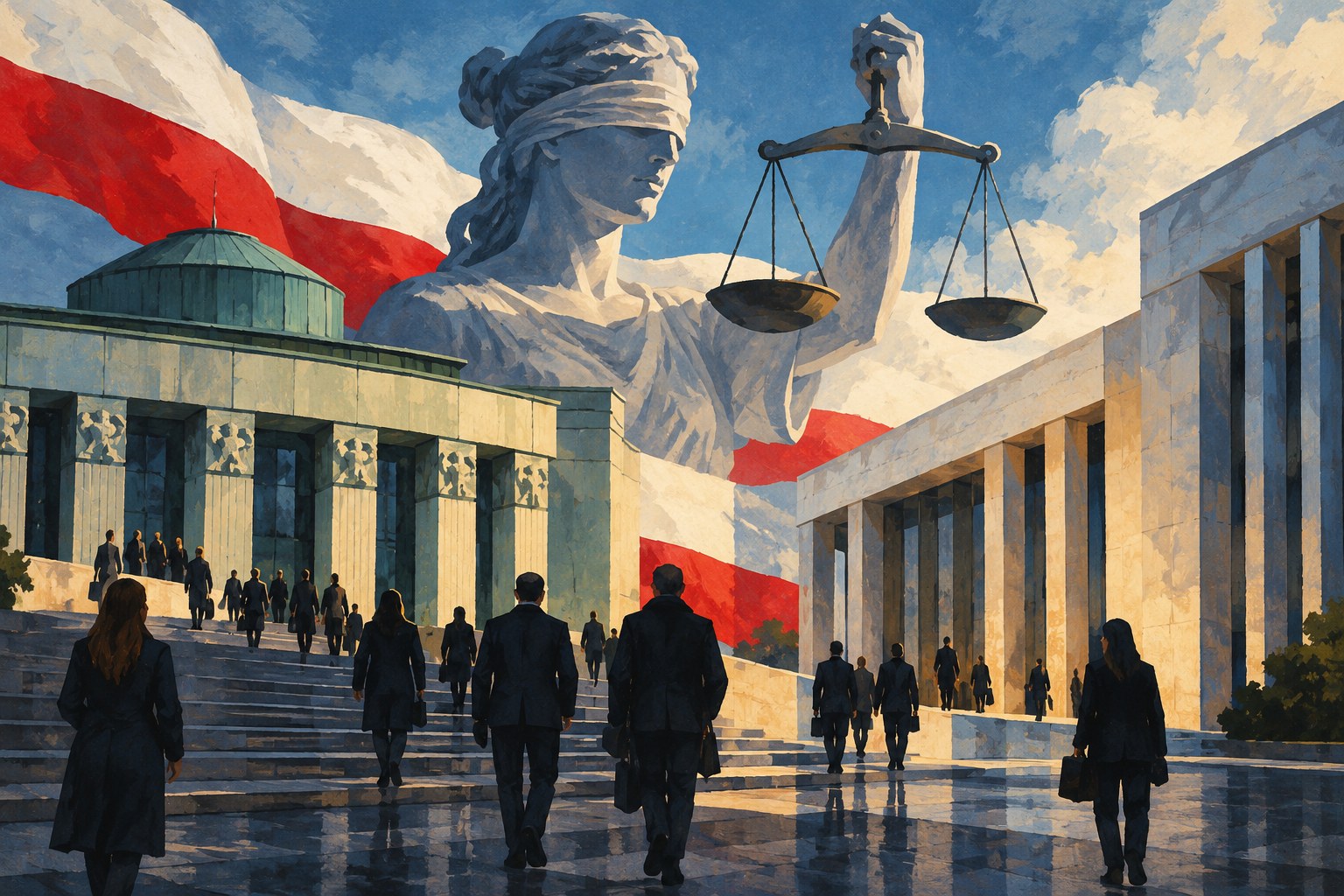
Poland’s Constitutional Tribunal crisis has moved beyond political messaging into the practical control of an institution. A work-organisation notice issued by Anna Korwin-Piotrowska, who is described as directing the Tribunal’s work, says that president Bogdan Święczkowski and vice-president Bartłomiej Sochański may not enter the Tribunal building after their official duties were suspended, TVN24 reports.
That does not settle the underlying legal dispute. The material supplied does not include the full suspension decisions, the legal basis for barring entry, or an independent ruling assessing those measures. It would therefore be wrong to present the notice as final proof that the new management arrangement is lawful. But it is more than a symbolic exchange: it concerns operational control of the institution’s workplace.
The response from the Supreme Court raises the stakes further. First President Zbigniew Kapiński has called an extraordinary General Assembly of Supreme Court judges for 3 November. TVN24 reports that the agenda includes a resolution on threats to Poland’s constitutional order; Polsat News says the discussion will focus in particular on judicial independence. This is an institutional response to the crisis, not simply another political statement.
The strongest counterargument deserves weight. The president and opposition circles continue to argue that suspending the Tribunal’s former leaders and restricting their access lack a lawful basis, while the government side characterises its actions as restoring the rule of law. The supplied excerpts do not provide the full legal documents or an independent judicial determination that could decide between those claims. Neither side’s assertion should be treated as self-validating.
Our judgment is that rival claims of “illegality” are no longer an adequate way to manage this dispute. When the institution at issue is meant to arbitrate constitutional questions, public and verifiable authority, interim operating rules and a route out of the confrontation matter more than competing labels. The next concrete test is whether the Supreme Court assembly adopts a resolution on 3 November and whether documents are made public that allow scrutiny of the basis for the Tribunal decisions.
Sources
- TVN24 · Source date: 2026-10-31
- TVN24 · Source date: 2026-11-01
- Polsat News · Source date: 2026-10-31
Independent editorial content. WUA is not affiliated with any political party. 2026-11-01