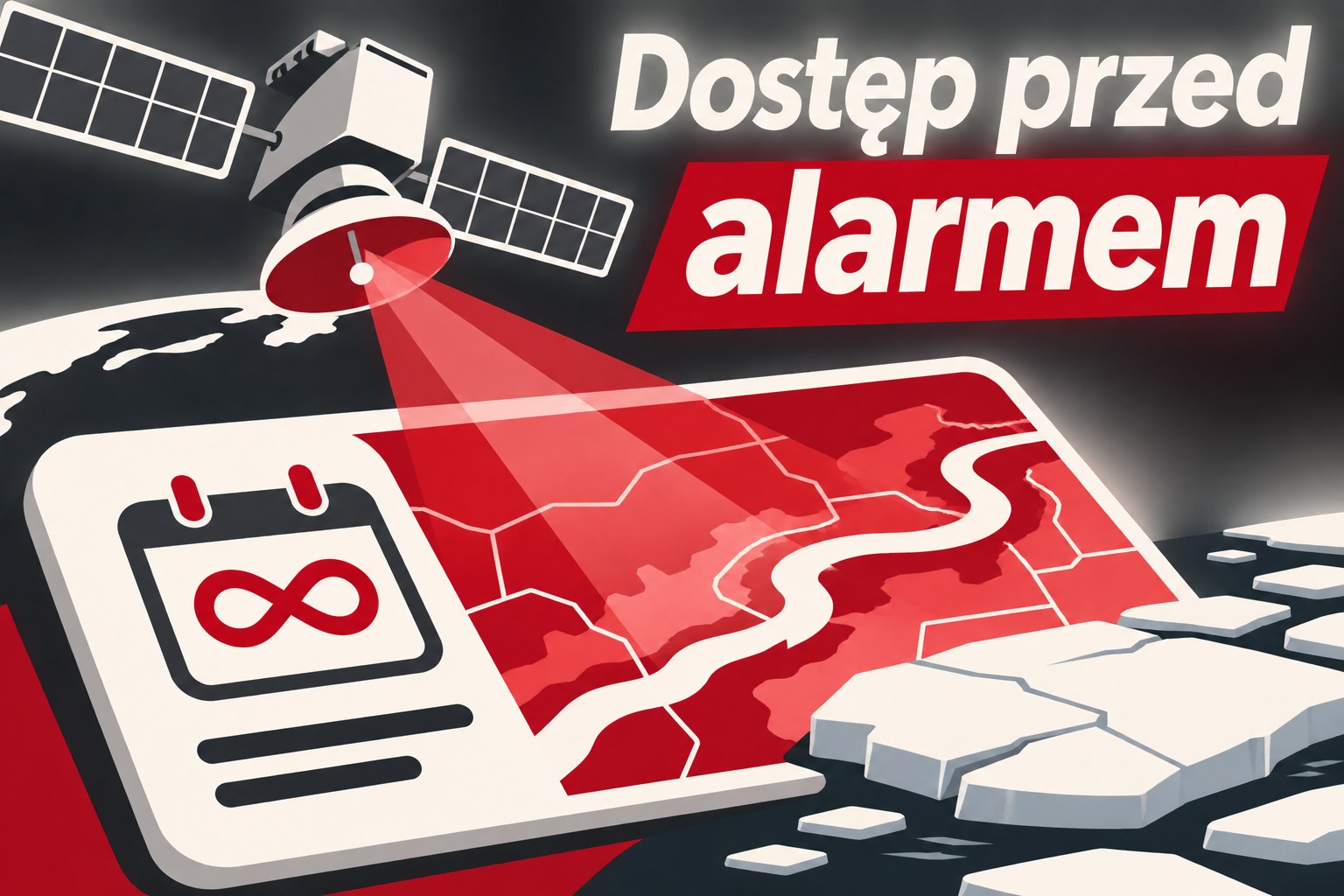
ICEYE and Poland's Space Research Centre of the Polish Academy of Sciences, CBK PAN, have signed an agreement intended to give emergency services permanent access to satellite data on floods, fires and river ice. Its significance is less about launching a new satellite tool than about ending the need to activate the service separately for each emergency.
ICEYE said the subscription-based access will be provided through Civil Security Hub Poland, the national node in the European Space Agency's Space Resilience Nodes initiative, run by CBK PAN's Crisis Information Centre. The intended users include the State Fire Service, regional crisis teams and hydrological services.
That is a useful operational change. During a fast-moving emergency, arranging access to a tool can itself create delay when responders need a rapid view of the affected area. Permanent availability cannot solve the practical challenges of a disaster response, but it removes one administrative hurdle to obtaining satellite information.
The company pointed to its cooperation with CBK PAN during flooding linked to Storm Boris in September 2024, when satellite data reached the Crisis Information Centre every six hours. ICEYE says its systems can forecast major floods up to four days ahead, update flood-extent maps as often as every three hours, and provide water-depth and individual-building damage data within a day of peak water levels. Those are company-stated capabilities; the supplied report does not provide an independent assessment of their performance or evidence from an operation under the new contract.
The agreement also covers pilot monitoring of forest fires and trial winter-to-spring monitoring of river ice, intended to identify ice-jam flood risks earlier. ICEYE's synthetic-aperture radar can observe terrain at night and through cloud, rain and smoke. The report does not disclose the contract's value, duration or detailed scope. Even so, the decision has a sound public-safety logic: emergency systems should establish access to information before a disaster, rather than assemble it after one begins.
Sources
- Nauka w Polsce · Fundacja PAP — Źródło: Nauka w Polsce (Fundacja PAP) (https://naukawpolsce.pl/) · Source date: 2026-11-13
Independent editorial content. WUA is not affiliated with any political party. 2026-11-13