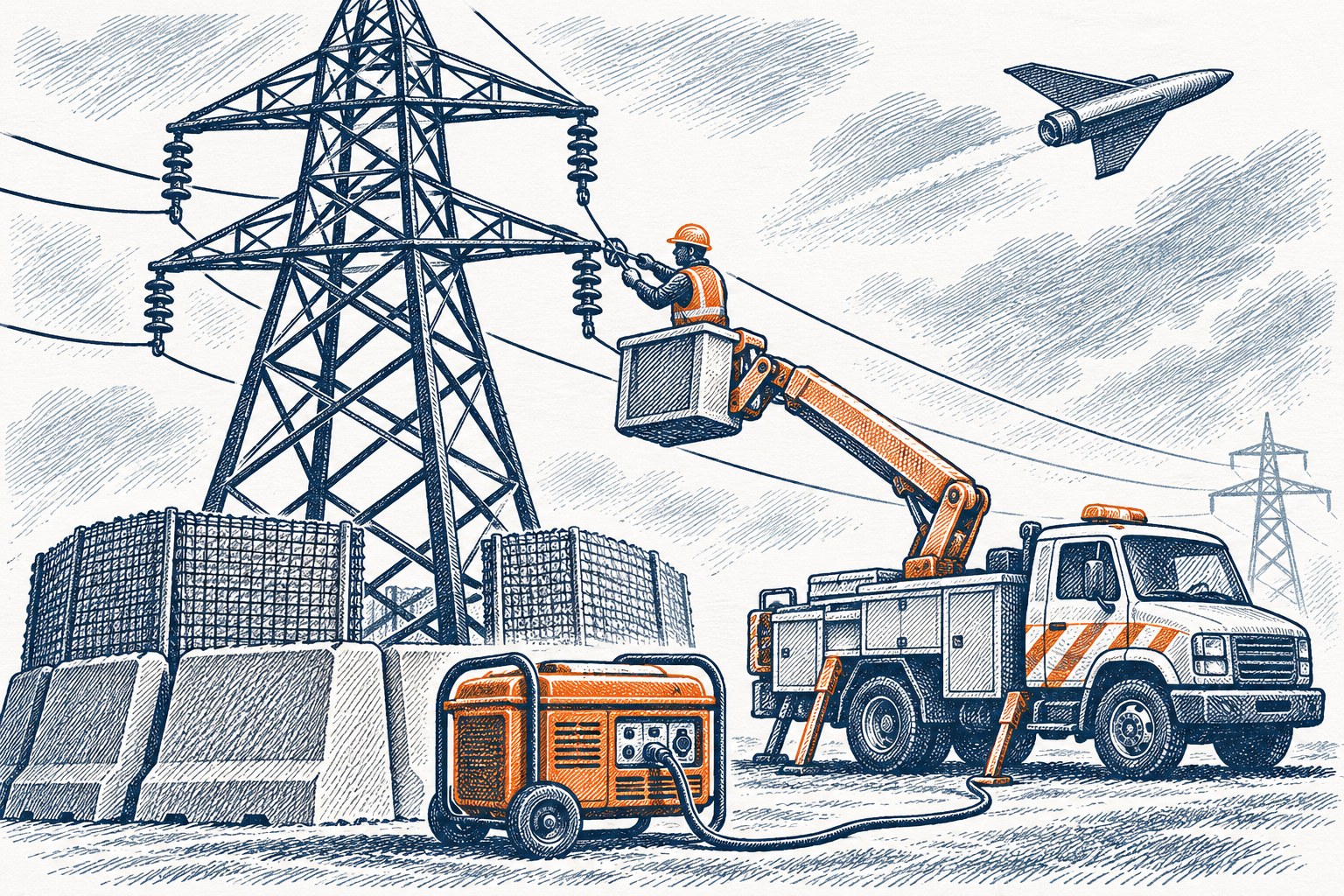
Prime Minister Serhii Koretskyi said on 16 November that Russia could use up to 6,500 jet-powered drones against Ukraine during November if the current trend continues. That is a government forecast, not a count of launches already made. Its practical implication is that energy protection cannot credibly mean sealing every part of the grid from attack.
In an interview with Radio Svoboda reported by Ukrainska Pravda, Koretskyi compared the possible November total with about 530 jet-powered Shahed drones in August. He also cited Russia’s use of guided aerial bombs, missiles and fibre-optic FPV drones. The comparison frames the danger as sustained pressure on repair capacity, backup power and electricity distribution, rather than a threat confined to one power plant.
Koretskyi said the government, president and local authorities were working to protect energy facilities and provide backup power for critical infrastructure. But he also set out the limit of that effort: transmission lines and large distribution installations cannot be fully covered, so energy workers are focusing on restoring them quickly.
That is the more useful standard than a promise of complete protection. At the projected scale, grid resilience depends on a combination of physical protection, backup power and the ability to return damaged nodes to service quickly. Rapid repair cannot remove the danger to cities and residents, but it is an essential response where the network cannot be comprehensively shielded.
The 6,500 figure should nonetheless be treated as Koretskyi’s forecast. The supplied report does not set out its methodology, precise reporting period or full definition of jet-powered drones. It describes a scenario the government says it is preparing for, rather than an established November total.
Sources
- Українська правда · Source date: 2026-11-16
Independent editorial content. WUA is not affiliated with any political party. 2026-11-16