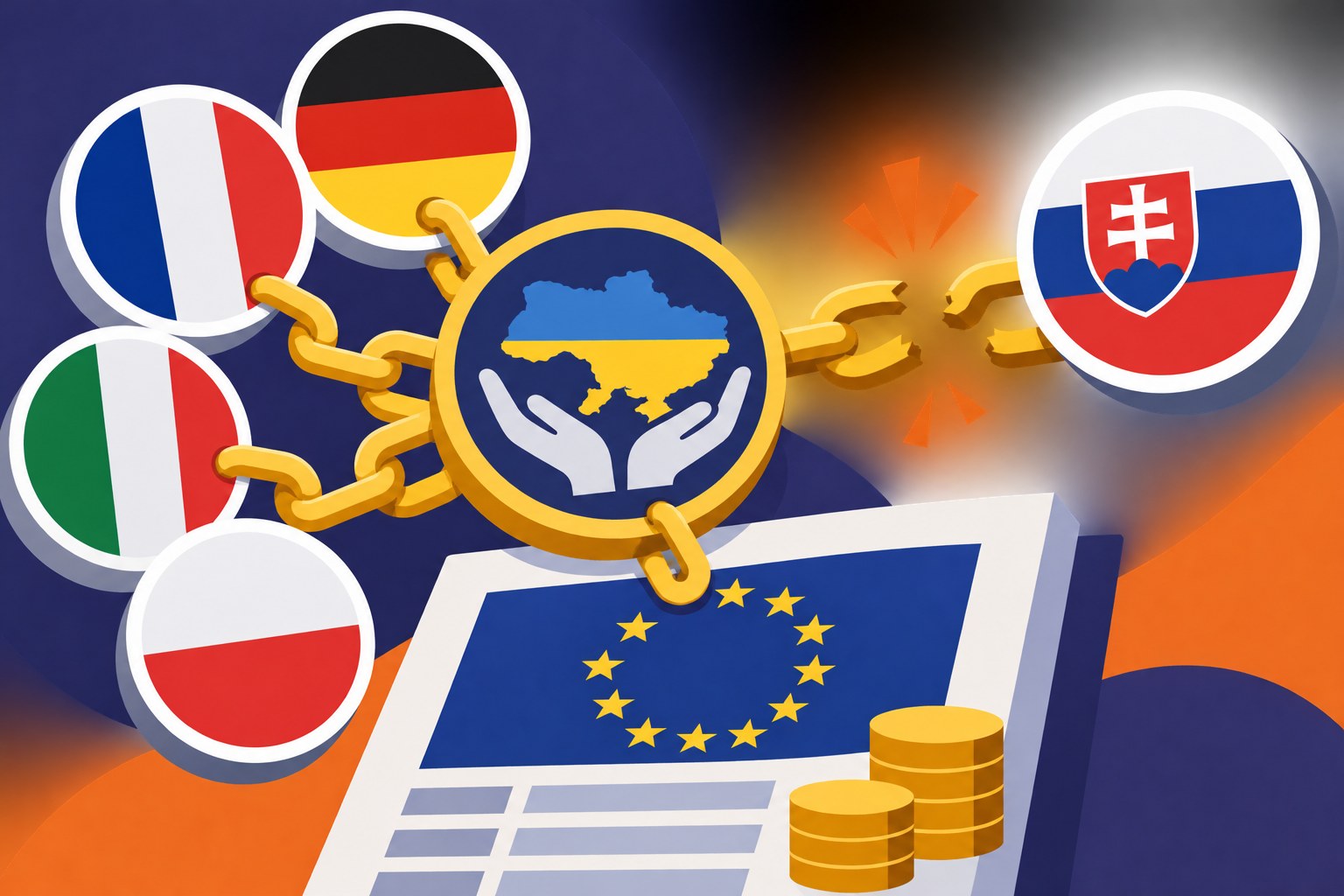
Slovak Prime Minister Robert Fico said on 10 November that Slovakia would not join what he described as a new 70 billion loan for Ukraine and would veto a related decision if it were tied to the EU budget. His intervention turns German Chancellor Friedrich Merz’s plan to embed Ukraine financing in European budget commitments into an open dispute over how collective support can be agreed.
At a press conference in Bratislava, Fico said Slovakia would not participate in the loan. He added that if Merz required every EU country to agree to a new loan while using the EU budget as leverage, Slovakia would veto the decision. Ukrainska Pravda reported the remarks from Fico’s public statements.
That response exposes the central vulnerability in Merz’s approach. Merz has said that all EU states should finance support for Ukraine and that the relevant commitments should be set in the European budget, according to a separate Ukrainska Pravda report. The strategy seeks a more durable, shared basis for financing. But once the issue is placed inside budget negotiations, dissenting governments may use the decision-making process as leverage.
Fico’s statement does not mean an EU financing mechanism has already been blocked. The supplied material contains no formal loan proposal, no explanation of how the 70 billion figure was calculated, and no description of the legal procedure in which a Slovak veto could apply. It also contains no immediate response from Berlin, the European Commission or other member states.
Still, the political obstacle is now concrete. Embedding Ukraine financing in the EU budget cannot by itself produce agreement among member states. Slovakia’s public refusal means that any future arrangement will require either a broader compromise or a financing route that does not depend on every member state’s consent.
Sources
- Українська правда · Source date: 2026-11-10
- Українська правда · Source date: 2026-11-10
Independent editorial content. WUA is not affiliated with any political party. 2026-11-10
Merz links the EU’s 2028–2034 budget to Ukraine financing: what changes