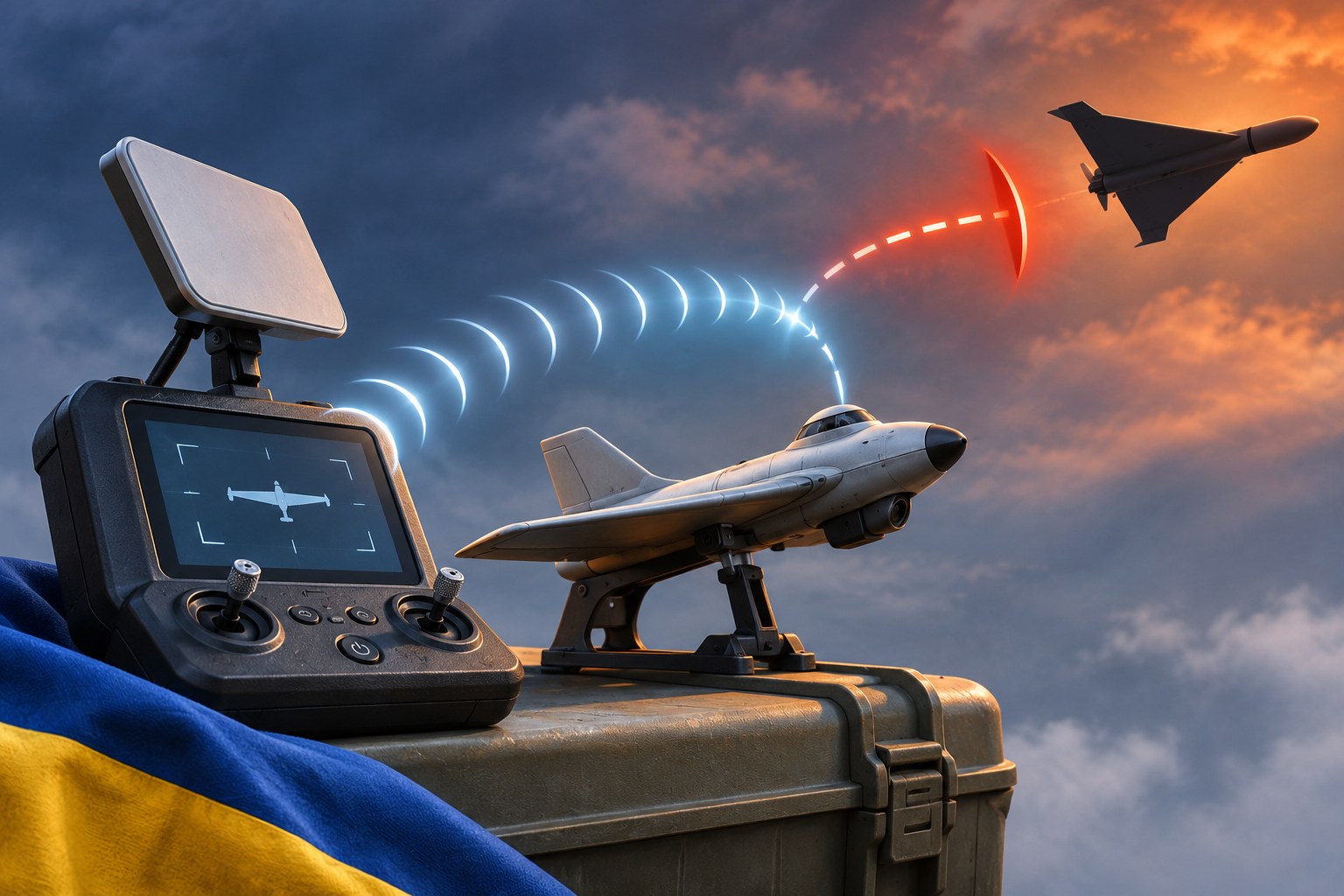
President Volodymyr Zelenskyy said speed limits on Starshield terminals are preventing Ukrainian interceptor drones from catching Russian jet Shaheds. If the threshold he described breaks the control link between an operator and an interceptor, it is more than a technical footnote: it is a direct constraint on air defence.
Zelenskyy said Ukrainian interceptor drones lose contact with their operators at 161 km/h, or 100 mph. He linked the problem to terminal restrictions along the front line and in temporarily occupied territories, saying the drones therefore cannot keep up with jet-powered Shaheds.
The significance of the claim lies in its specificity. Ukraine is not only describing a shortage of interception tools; it is identifying a communications parameter that it says constrains drones already in service. Zelenskyy said he had instructed the Foreign Ministry, Defence Ministry and presidential office to work with the United States and SpaceX to remove the restrictions.
That remains a presidential statement, not an announced policy change. The report by Ukrainska Pravda includes no explanation from SpaceX, Starshield or the US government about the mechanism behind the limits, their geographic scope or a timetable for any revision. There is therefore no basis in the supplied material to assign responsibility to a particular party or to calculate an effect on interception rates.
Still, Kyiv’s request identifies an operational issue that merits attention: against faster drones, the reliability of the operator link may matter as much as the interceptor’s own performance. A response from the United States or SpaceX to Ukraine’s request would be the next consequential development.
Sources
- Українська правда · Source date: 2026-11-15
Independent editorial content. WUA is not affiliated with any political party. 2026-11-15