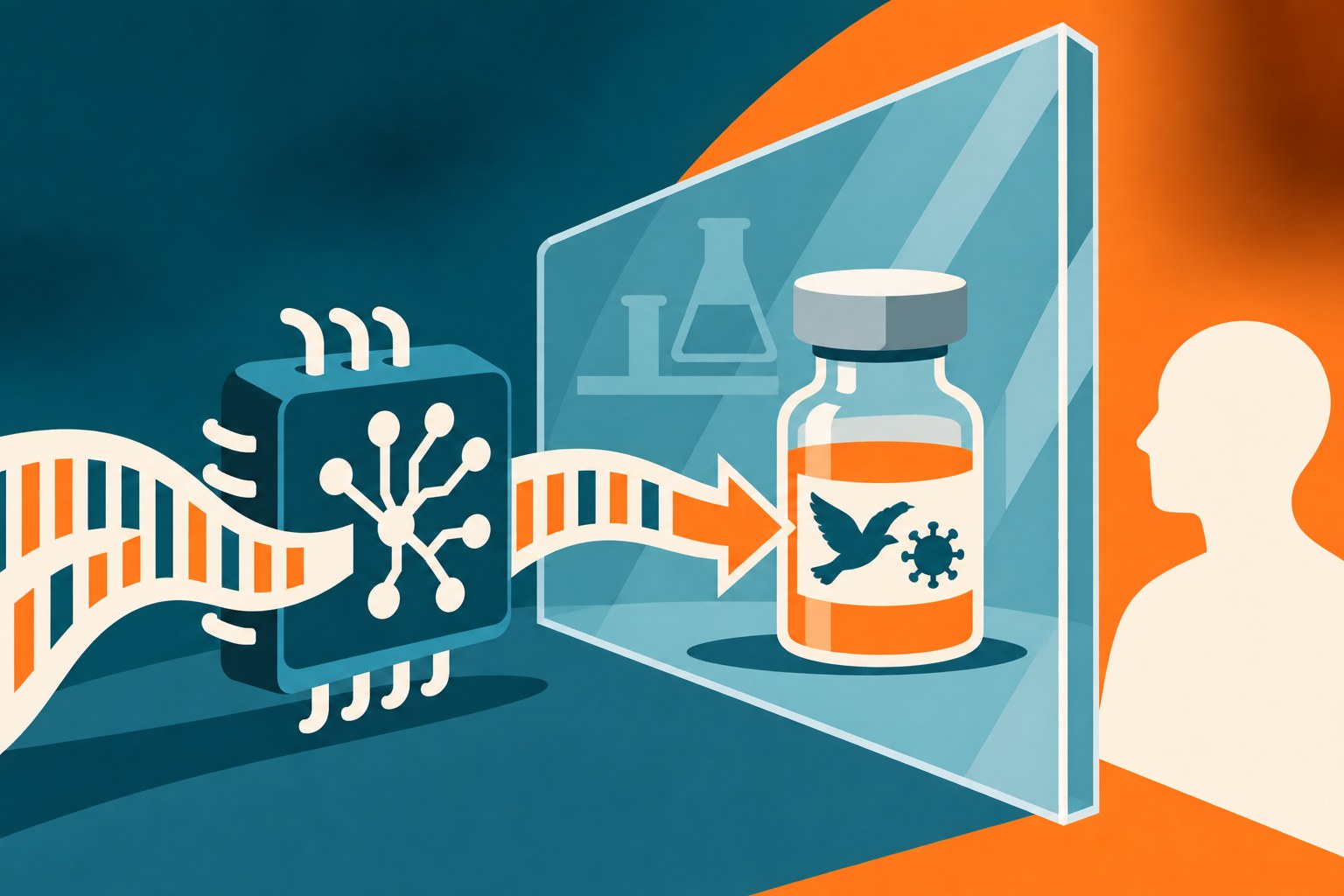
The Cambridge team’s AI-designed bird-flu vaccine matters because it may change how vaccine candidates are selected. It does not yet amount to a broad human vaccine.
Dagens Nyheter reports that the researchers used an AI tool to analyse genetic sequences from identified avian-influenza variants. The tool proposed several “super-antigen” candidates, which the researchers then screened in cells before incorporating selected candidates into a vaccine.
The vaccine was tested in mice and ferrets exposed to different bird-flu variants. According to DN, every animal given the new vaccine at a lower dose survived. About half of the animals given one of the WHO candidate vaccines died, while all unvaccinated control animals died. That is a notable preclinical result, and ferrets are widely used in influenza research because their response to flu viruses resembles humans’ in important respects.
The more useful conclusion, however, concerns the design process rather than the label “supervaccine”. Influenza changes rapidly, and vaccine development often has to catch up with a strain already in circulation. AI could help researchers sift large sequence datasets and identify antigens with potential coverage across more variants earlier in that process.
That potential has clear limits. DN quotes Ali Mirazimi, an adjunct professor at Karolinska Institutet, saying AI is particularly useful when a virus, such as influenza, has extensive available data. But he also identifies the central challenge: a future variant may bind to the protein differently, making the vaccine less effective or ineffective.
The supplied report does not say that human clinical trials have begun. The study is nevertheless relevant to pandemic preparedness because it offers a possible way to improve the starting pool of vaccine candidates before a new variant dictates the timetable.
Sources
- Dagens Nyheter · Source date: 2026-11-11
Independent editorial content. WUA is not affiliated with any political party. 2026-11-11